Introduction
A single failed component can bring an entire reefer container offline — and in Singapore's heat, unrefrigerated cargo begins deteriorating within hours. For fleet operators, cold chain logistics companies, and pharmaceutical shippers, the question is never whether a part will fail, but when. Proactive parts stocking is the difference between a 30-minute repair and a 48-hour wait for overseas freight. AML stocks a comprehensive range of reefer machinery parts in Singapore for all major brands including Carrier, Thermo King, and Daikin. This guide lists the critical spares every operator should keep accessible, with shelf-life guidance and sourcing tips for the Singapore market.
Why Singapore's Climate Accelerates Parts Wear
Singapore's combination of high ambient temperature (27–35°C year-round) and consistently high humidity (75–90% RH) places reefer refrigeration systems under greater sustained stress than in temperate climates. Specific impacts:
- Condenser coils work harder to reject heat against a hot ambient environment, increasing compressor load and accelerating contactor and capacitor wear
- High humidity accelerates corrosion of electrical terminals, sensor housings, and uncoated metal components
- Tropical UV exposure degrades door gasket rubber faster than in northern climates
- Frequent thermal cycling (hot ambient vs cold interior) stresses door hinge seals and drain line components
The Essential Reefer Spare Parts Checklist
1. Evaporator Fan Motors
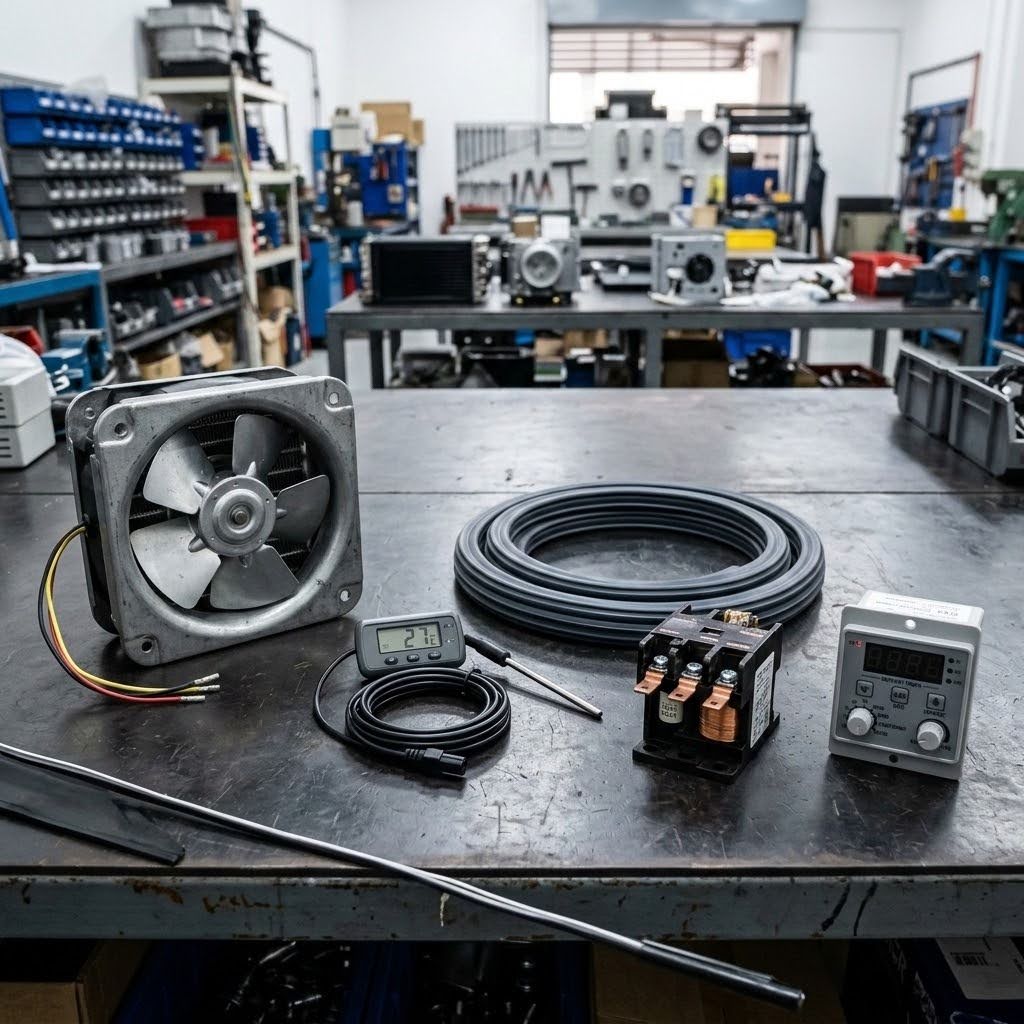
The evaporator fan circulates cold air over cargo 24 hours a day. When it fails, airflow drops and temperature uniformity collapses — cargo near the door warms while cargo near the evaporator stays cold. Fan motor failure is one of the most common breakdown causes in Singapore's high-humidity environment. Shelf life: indefinitely if stored dry. Stocking recommendation: 1–2 per container type in your fleet.
2. Temperature and Humidity Sensors
Faulty sensors cause two failure modes: the controller thinks the unit is colder than it is (allowing cargo to warm) or warmer than it is (causing unnecessary over-cooling or freeze damage to chilled cargo). Sensors are inexpensive and lightweight — there is no reason not to carry spares. Shelf life: 3–5 years when stored at room temperature, away from moisture.
3. Defrost Timers and Defrost Heaters
In Singapore's humid climate, evaporator coil icing is a frequent problem — moisture-laden air entering the container freezes onto the coil, restricting airflow. Defrost timers control the heating cycle that melts this ice. A failed defrost timer leads to rapid coil icing, loss of airflow, and rising cargo temperatures within 12–24 hours. Defrost heaters are the heating elements themselves. Both are compact, low-cost items worth stocking.
4. Compressor Contactors and Run Capacitors
The contactor is an electrical switch that engages and disengages the compressor motor. It handles thousands of switching cycles per year and the contacts eventually pit and burn, causing the compressor to fail to start. Run capacitors provide the starting torque for single-phase fan and compressor motors. Both are high-failure-rate electrical components under tropical conditions and should be treated as consumables for any fleet of more than 5 units.
5. Door Gaskets and Hinge Seals
Door gaskets are the magnetic rubber seals that run around the perimeter of the container door. A compromised gasket allows warm, humid air to infiltrate continuously — increasing refrigeration load, accelerating compressor wear, and causing icing on the evaporator. In Singapore's heat, a failed gasket can cause a 3–5°C temperature rise in the container within hours. Inspect gaskets monthly; replace annually as preventive maintenance.
6. Drain Hoses and Drain Line Heaters
Condensate from the evaporator drains via a plastic drain hose. In freezer-range containers, this hose is heated to prevent ice blockages. A blocked drain causes water to pool inside the container and eventually overflow onto cargo. Drain hoses are inexpensive, deteriorate from UV and cold cycling, and should be inspected every service interval.
Parts Shelf Life and Storage Guidelines
| Part | Shelf Life / Storage Notes |
|---|---|
| Evaporator fan motor | Indefinite — store dry, rotate stock every 3 years |
| Temperature sensor | 3–5 years — avoid humidity, store in original packaging |
| Defrost timer | 5+ years — store in sealed packaging away from moisture |
| Defrost heater | Indefinite — inspect for physical damage before use |
| Compressor contactor | 3–5 years — avoid humidity, inspect contact surfaces before use |
| Run capacitor | 5–8 years — store at room temperature, test capacitance before use |
| Door gasket (magnetic) | 2–3 years — store flat, avoid compression set |
| Drain hose | 2–3 years — UV degrades rubber; inspect for cracking before fitting |
Early Warning Systems: Monitoring Before Parts Fail
The best spare parts strategy is one you rarely need to use. Wireless remote monitoring for reefer containers gives operators real-time temperature and humidity data plus instant alerts when readings drift. Unusual temperature patterns — a container that cycles more frequently than normal, or one that takes longer to pull down to setpoint — are early indicators of compressor strain, coil icing, or door seal failure. Catching these signals early allows scheduled maintenance rather than emergency repair.
Building a Parts Inventory: Practical Tips for Singapore Operators
Setting up a functional spare parts inventory does not require stocking every conceivable component. A focused, well-organised inventory covering the high-failure items above provides coverage for the majority of breakdown scenarios. Practical recommendations for Singapore-based fleet operators:
- Maintain one set of consumable parts (gaskets, capacitors, contactors, sensors) per every 5 reefer units in your fleet
- Store parts in a cool, dry environment — Singapore's ambient humidity will degrade electrical components and rubber seals if stored in an unventilated outdoor container
- Label every part with its brand compatibility, part number, and date of purchase — critical for rotating stock before shelf life expires
- Review your inventory against actual breakdown history every 6 months — if the same part is failing repeatedly, increase stock levels for that specific item
Frequently Asked Questions
Q1: Should I use OEM parts or aftermarket alternatives?
For critical components like compressors, contactors, and sensors, OEM or OEM-equivalent parts are strongly recommended. Substandard aftermarket parts may be cheaper upfront but often fail sooner under Singapore's operating conditions, invalidating warranty coverage and creating liability exposure for pharmaceutical and food cargo.
Q2: How do I know which parts are compatible with my reefer unit?
Reference your reefer container's unit model number (found on the controller panel or data plate). AML's parts team can cross-reference your model to confirm compatibility for all major Carrier, Thermo King, and Daikin units.
Q3: Where can I source genuine reefer parts quickly in Singapore?
AML maintains in-Singapore stock of genuine reefer machinery parts in Singapore for all major brands. Same-day or next-day supply is available for common components. Contact AML directly for urgent parts requirements.
Q4: How often should I service my reefer container?
AML recommends a full service every 500–1,000 operating hours (approximately every 3–6 months for continuously running units). In Singapore's tropical conditions, condenser coil cleaning should be done more frequently — quarterly at minimum.
Q5: Can AML supply parts for reefer containers not purchased from them?
Yes. AML supplies parts for all major reefer brands regardless of where the container was sourced. Bring your unit model number and our parts team will confirm availability.
Keep your cold chain running. AML stocks genuine reefer machinery parts for Carrier, Thermo King, and Daikin units with fast Singapore-wide supply. Contact us for a parts consultation or to set up a preventive maintenance and repair of reefer containers schedule. Enquire with AML today.
