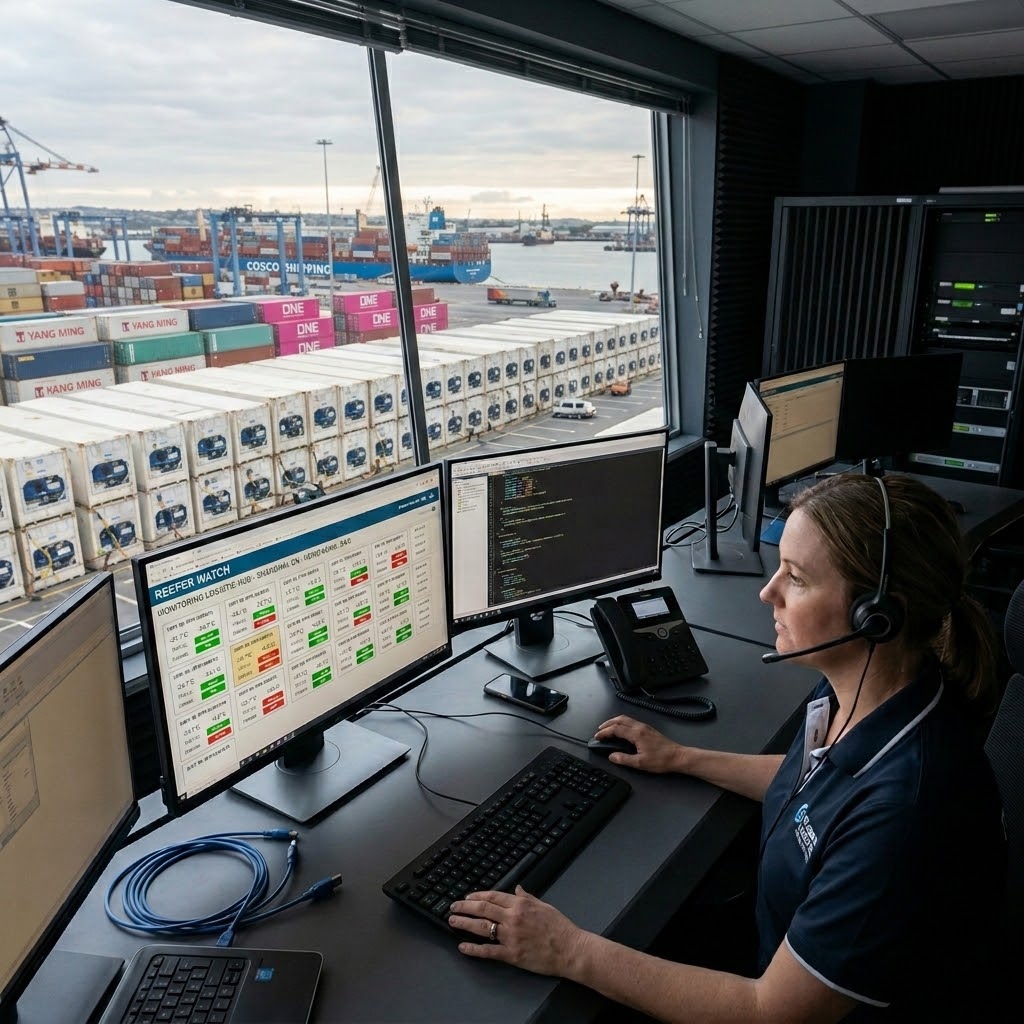
What Is Remote Monitoring for Reefer Containers?
Remote monitoring is a wireless system that continuously tracks the condition of a refrigerated container and transmits data to a cloud platform. Logistics managers can access this information from any device, anywhere in the world.
Critical Data Points Monitored
- Temperature — Core cargo condition, excursions trigger instant alerts
- Humidity — Critical for produce, flowers, and certain pharmaceuticals
- Location (GPS) — Know exactly where your container is at all times
- Door status — Unauthorized access detection
- Power status — Alerts if reefer unplugs from socket
Why Real-Time Visibility Matters
Singapore is a global transshipment hub, moving over 37 million TEUs annually. Real-time monitoring goes beyond compliance — it protects your bottom line.
Common Cold Chain Risks Without Remote Monitoring
- Reefer unit failure — Cargo warms up unnoticed for hours or days
- Power disconnection — Container unplugged at port, battery lasts only 30-120 minutes
- Temperature setpoint error — Wrong setting applied before dispatch
- Door left open — Warm air enters, condensation forms
Without remote monitoring: You discover the problem at destination — when cargo is already rejected.
With remote monitoring: You receive an SMS or email alert within minutes.
AML's Wireless Real-Time Monitoring System
System Components
- Wireless sensor — Installed inside reefer, measures temperature and humidity
- GPS module — Tracks container location continuously
- Cellular transmitter — Sends data to cloud via 4G/5G networks
- Cloud dashboard — View all containers on one screen
- Mobile app — Receive alerts and check status from smartphone
Key Features
- Real-time alerts via SMS, email, or push notifications
- Historical data logging for compliance and audits
- Geofencing — get notified when container enters or leaves designated zones
- 30+ days battery backup even if container loses power
- Multi-user access — share dashboard with customers or regulators
Case Study 1: Pharmaceutical Logistics Provider
Challenge: Vaccines require strict +2°C to +8°C. Client previously discovered excursions only at destination — resulting in over $200,000 in annual rejected shipments.
Solution: AML equipped 50 reefer containers with wireless remote monitoring.
Results
- Rejected shipments per year: 12 down to 2
- Annual loss from spoilage: $216,000 down to $36,000
- Response time to excursion: 6–24 hours down to 5–15 minutes
ROI: Monitoring system paid for itself within 3 months.
Case Study 2: Perishable Food Exporter
Challenge: Singapore seafood exporter shipping frozen tuna at -18°C to Japan. One undetected reefer failure caused $85,000 in spoiled tuna.
Results After AML Monitoring
- Spoilage incidents per year: 3–5 down to 0
- Insurance claims: none in 18 months
- Customer retention: 70% up to 95%
Temperature Loggers vs. Real-Time Monitoring
- Live alerts: Logger — No | Real-Time — Yes (within minutes)
- GPS location: Logger — No | Real-Time — Yes
- Intervention window: Logger — None | Real-Time — Yes (act before spoilage)
Use real-time monitoring for pharmaceuticals, fresh produce, seafood, and flowers. Use temperature loggers as backup or for low-risk dry goods.
The Future of Cold Chain Monitoring
- AI-powered predictive alerts — System learns normal patterns and flags anomalies early
- Blockchain integration — Immutable temperature records for pharma compliance
- Solar-powered sensors — Eliminating battery changes for long-term installations
Stop Discovering Spoilage at Destination — Start Preventing It in Real Time
Reach our team at sales@aml.sg or via WhatsApp: +65 8268 3359.
Enquire with us today at https://aml.sg
