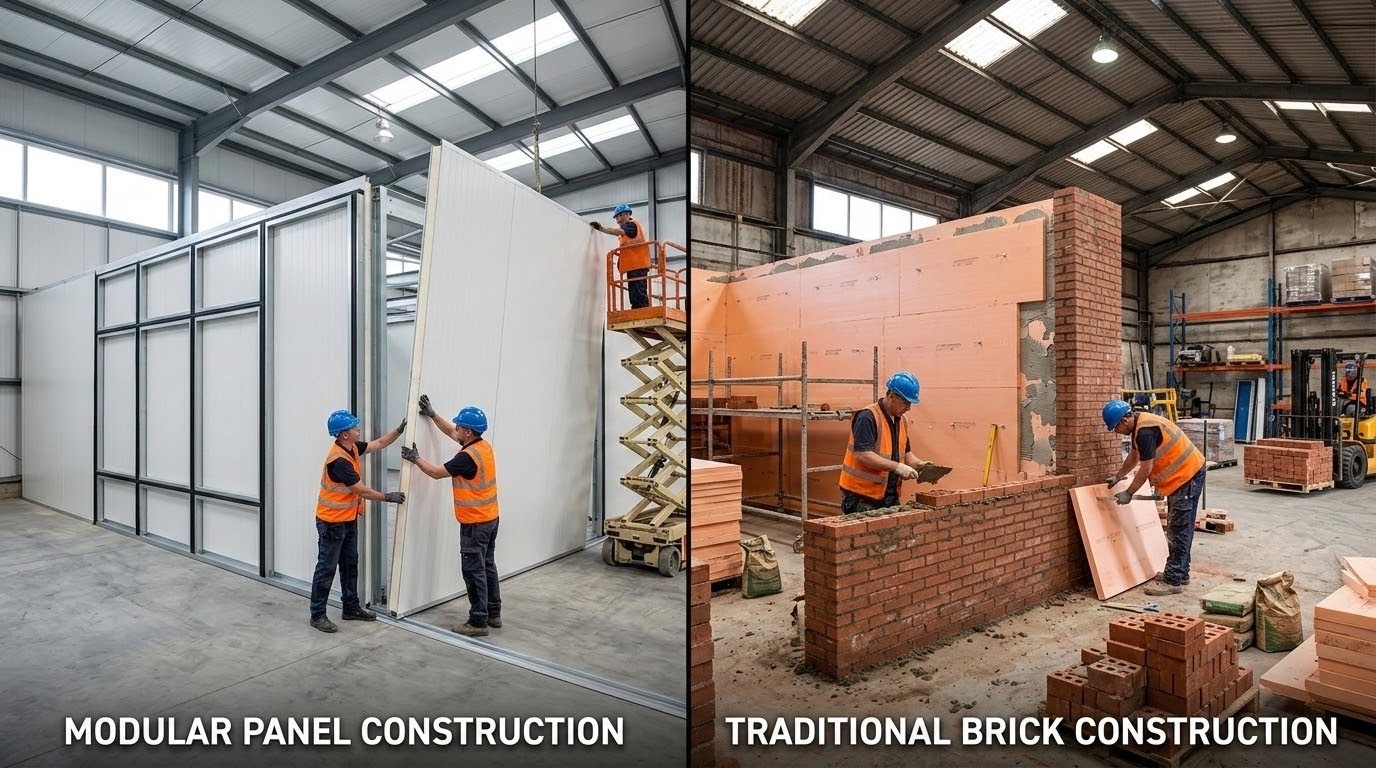
Food manufacturers, warehouses, and logistics companies weighing a new cold storage investment in Singapore increasingly find themselves choosing between two paths: modular cold storage systems that can be assembled and reconfigured relatively quickly, or a traditionally built cold room constructed on-site to a bespoke specification. Both approaches can deliver reliable temperature-controlled storage, but they differ meaningfully in installation speed, scalability, and total cost of ownership. This comparison breaks down where each option makes sense, so you can make an informed decision before committing to either path with a cold room contractor.
What Sets Modular Cold Storage Apart
Modular cold storage is built from prefabricated insulated panels manufactured off-site and assembled on location, similar in principle to how a reefer container is constructed but purpose-built for stationary storage. Because the panels are factory-made to consistent tolerances, installation timelines are typically shorter and more predictable than a traditional build, and the system can often be disassembled and relocated or reconfigured if a business moves premises or needs to expand capacity later. This flexibility makes modular cold storage particularly attractive for businesses still scaling, or for sites where a long-term lease isn't guaranteed.
What Sets Traditional Cold Rooms Apart
A traditionally built cold room is constructed in place, typically using site-applied insulation and a refrigeration system designed specifically around the building's structure and layout. Singapore Food Agency guidance on cold chain management notes that facility design should account for product-specific temperature zoning regardless of construction method, and a traditional build can make better use of irregular floor plans or unusual ceiling heights than a modular system built from standard panel dimensions. For very large installations, a bespoke build sometimes achieves a lower cost per cubic metre at scale. The trade-off is a longer construction timeline and less flexibility if requirements change after the room is built — customize coldroom modifications to a traditional build usually involve more structural work than adjusting a modular system. Traditional builds also tend to suit sites where the cold room needs to be integrated tightly with existing building services, such as shared drainage, electrical risers, or structural load-bearing walls, since a contractor can design around these constraints directly rather than working within the fixed dimensions of standard modular panels.
Comparing the Two on Installation Speed
Modular cold storage systems generally install faster because the bulk of manufacturing happens off-site in parallel with site preparation, and assembly itself is largely a matter of fitting pre-made panels together. A traditional cold room build, by contrast, involves sequential on-site work — structural preparation, insulation application, and refrigeration installation typically can't all happen in parallel — which extends the overall timeline, particularly for larger or more complex spaces.
Comparing the Two on Scalability
This is where modular cold storage has a clear advantage: because the system is built from standardized panels, expanding capacity later — or relocating the entire unit to a new site — is a matter of adding or reassembling panels rather than undertaking new construction. A traditional cold room's scalability is more limited unless the original design specifically planned for future expansion, which not every cold room contractor accounts for at the outset.
Comparing the Two on Total Cost of Ownership
Upfront costs can go either way depending on project size — modular systems often have a cost advantage on small to mid-sized installations, while very large traditional builds can sometimes achieve a lower per-unit cost at scale due to reduced material waste. Where the comparison shifts meaningfully is long-term flexibility: a business that later needs to relocate, expand, or reconfigure a modular system generally faces a lower cost to do so than one that needs to modify or rebuild a fixed structure. For businesses still uncertain about long-term site tenure or future capacity needs, this flexibility often outweighs a marginal difference in upfront cost. It's also worth factoring in energy efficiency over the system's operating life — both approaches can be built to a similar insulation standard, but a modular system's factory-sealed panel joints sometimes hold their thermal performance more consistently over time than site-applied insulation, which can degrade unevenly if not installed with equal care across every section of the room.
A Third Option: Reefer Container-Based Cold Storage
For businesses not yet ready to commit to either a modular system or a traditional build, a reefer container-based solution offers a lower-commitment starting point. A single reefer container can be deployed quickly, requires minimal site preparation compared to either fixed option, and gives an operator real data on temperature control needs and daily volume before scaling up to a larger modular or traditional cold storage investment. This path is particularly common among F&B businesses and smaller logistics operators testing demand for a new product line or service area before building out permanent infrastructure, and it also gives a business real operating cost data to bring into negotiations with a cold room contractor further down the line.
Which One Fits Your Business?
As a general guide, businesses on shorter leases, still scaling operations, or needing storage that could move sites within the next few years tend to be better served by modular cold storage. Businesses with a confirmed long-term site, unusual space constraints, or very large storage requirements may find a traditional cold room build, handled by an experienced cold room contractor, delivers better value at that scale — our [LINK TO: Post 17 — Cold Room Contractor FAQ: What to Ask Before You Hire, With a Real Project Case Study] covers what to ask before committing either way. The International Institute of Refrigeration's guidance on cold storage facility design notes that insulation performance requirements are broadly similar across both construction methods, so the decision more often comes down to site constraints and growth plans than insulation quality alone. Many operators also start with a smaller reefer container-based solution before committing to either path, using it to validate volume and temperature requirements before a larger capital investment.
Frequently Asked Questions
Is modular cold storage as durable as a traditional cold room?
Yes, when properly installed and maintained — modular panels use the same insulation materials as many traditional builds, with durability depending more on installation quality than the construction method itself.
Can a modular cold storage system be relocated to a new site?
In most cases yes, which is one of its key advantages over a fixed traditional build, though relocation costs and feasibility depend on the specific system and site conditions.
How much faster is modular cold storage installation compared to a traditional build?
Timelines vary by project size, but modular installations are generally measurably faster since much of the manufacturing happens off-site in parallel with site preparation.
Can I customize a modular cold storage layout after installation?
Yes, this is one of the format's strengths — customize coldroom changes to a modular system typically involve less disruption than modifying a traditional build.
Which option is better for a small F&B business just starting out?
Modular cold storage is often a better fit for smaller or growing operations due to lower upfront commitment and easier future scalability.
Making the Right Choice
Choosing between modular cold storage and a traditional cold room comes down to your site's specific constraints, your growth plans, and how much flexibility you need over the next several years. Neither option is universally better — the right answer depends on details specific to your site and business trajectory that are worth discussing with a contractor directly rather than deciding from a comparison alone. AML designs and installs both approaches and can walk through which option fits your business, your space, and your budget. Contact AML today to discuss whether modular cold storage or a traditional build is the right fit for your next cold storage project.
REFERENCES:
- Singapore Food Agency. (2024). Guidelines on Cold Chain Management for Food Businesses. SFA. https://www.sfa.gov.sg
- International Institute of Refrigeration. (2021). Guide to Cold Storage Facility Design and Insulation Standards. IIR. https://iifiir.org
