Introduction
A failed reefer at 2am can mean a spoiled pharmaceutical shipment worth hundreds of thousands of dollars. In Singapore's tropical climate — where ambient temperatures regularly exceed 32°C and humidity stays above 80% year-round — the margin for error in cold chain operations is zero. Selecting a reefer container service provider is therefore one of the most consequential decisions a logistics manager, food importer, or pharmaceutical operator makes. Since 2005, Advance Marine & Logistics (AML.sg) has supported cold chain operators across Singapore and the Far East with end-to-end reefer solutions. This checklist-driven guide walks through the five criteria that separate reliable providers from costly risks.
Criterion 1: Fleet Age and Condition
A reefer container's reliability is directly correlated with its age and maintenance history. Units over 10 years old carry significantly higher breakdown risk because refrigeration systems (Carrier, Thermo King, Daikin) have expected service lives of 8–12 years under Singapore's operational load. Insulation degrades over time, raising the K-value and reducing cooling efficiency. Door gaskets harden and lose their seal, allowing warm humid air to infiltrate.
What to ask: Request the manufacturing year, last full service record, and pre-trip inspection (PTI) report for every unit you are considering. A reputable provider will provide these without hesitation. If they cannot or will not, move on.
Criterion 2: 24/7 Support and Response Times
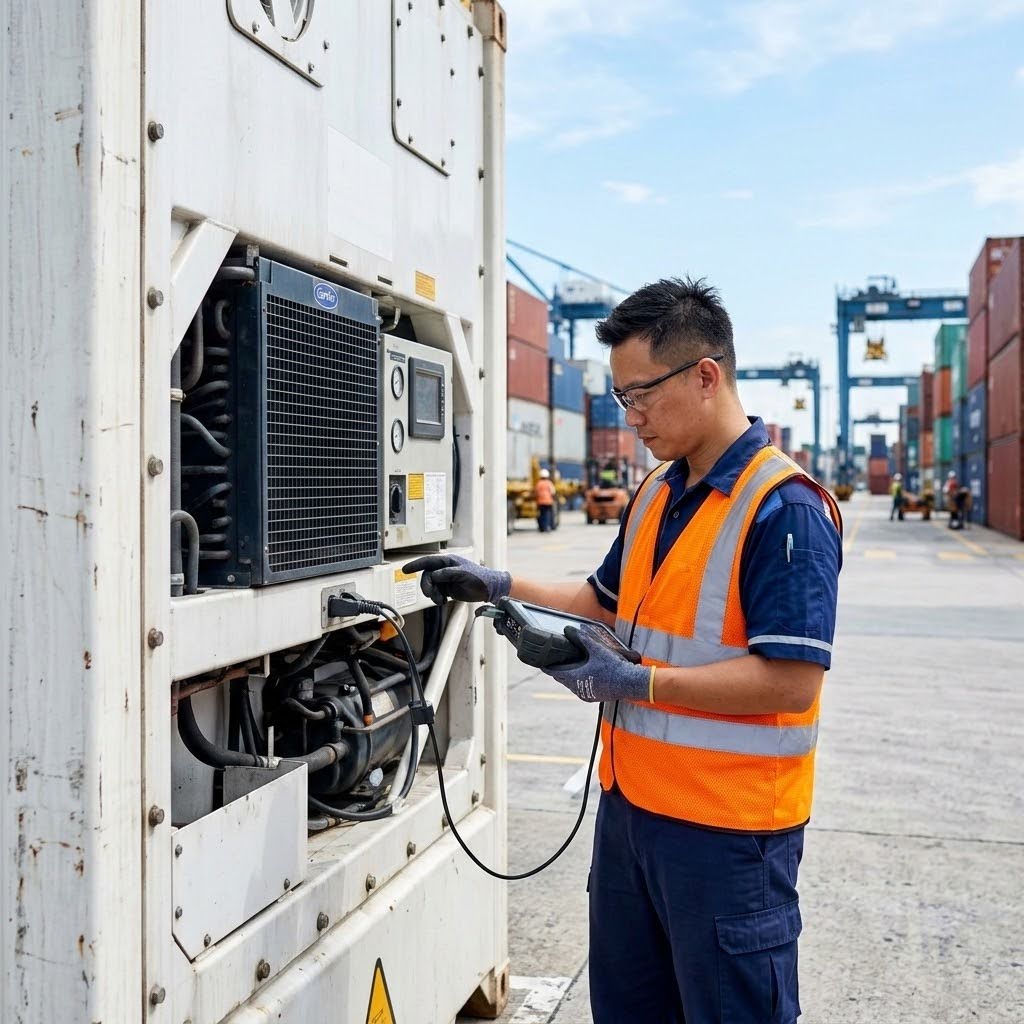
Cold chain breakdowns do not observe business hours. Your provider must offer genuine 24/7 emergency response with documented response time commitments. For pharmaceutical cargo, international GDP (Good Distribution Practice) guidelines require temperature excursion response within two hours. AML's maintenance and repair of reefer containers team is available around the clock with field technician deployment capability across Singapore and nearby Southeast Asian ports.
Red flags to watch for:
- 24/7 claims with no dedicated emergency hotline number
- Repair work outsourced to third-party contractors — slower response, less accountability
- No written SLA or guaranteed response time in the rental agreement
- Single point of contact with no backup when that person is unavailable
Criterion 3: Local Parts Availability
Even the best technician cannot repair a reefer without the right parts in stock. Providers that source components from overseas face lead times of days to weeks. AML maintains an in-Singapore inventory of genuine reefer container spare parts for all major brands — Carrier, Thermo King, and Daikin — enabling same-day or next-day repairs in the majority of breakdown scenarios. Critical parts that should always be locally stocked by any credible provider:
- Compressor contactors and run capacitors
- Evaporator and condenser fan motors
- Temperature and humidity sensors
- Defrost heaters and defrost timers
- Door gaskets and hinge seal sets
- Controller boards and display units
Criterion 4: Remote Monitoring Technology
Modern reefer management requires more than periodic manual temperature checks. Ask whether your provider offers wireless remote monitoring for reefer containers — a real-time IoT system that delivers temperature, humidity, and GPS location data to your phone or operations centre. Proactive alerting means you identify a temperature excursion before your cargo is affected, not after.
| Feature | Why It Matters for Your Operation |
|---|---|
| Real-time temperature alerts | Catch excursions before they become cargo losses |
| Humidity monitoring | Critical for pharma, fresh produce, and flowers |
| GPS location tracking | Full chain-of-custody visibility for audits |
| Data logging & report export | Required for GDP and HACCP documentation |
| 4G/LTE connectivity | Works inside warehouses and at remote port locations |
Criterion 5: Certifications and Compliance Track Record
For pharmaceutical, food, and clinical trial cargo, your provider's compliance credentials are as important as their operational capability. In Singapore, key standards and bodies to ask about include:
- Health Sciences Authority (HSA) — GDP compliance for pharmaceutical cold chain
- Singapore Food Agency (SFA) — food storage and temperature handling requirements
- ISO 9001 — quality management system certification
- Container Safety Convention (CSC) — valid certification plates on all units
- NEA/SCDF compliance — fire safety and environmental requirements for on-site storage
Ask for documented examples of how the provider has handled temperature excursion incidents — what their reporting process looks like, how they communicate with clients, and what corrective actions were taken. A provider with nothing to show has either not handled such incidents or prefers not to discuss them.
Red Flags to Avoid
| Red Flag | What It Signals |
|---|---|
| No physical Singapore workshop | Cannot respond quickly — offshore-only operation |
| Unwilling to share PTI reports | Suggests maintenance shortcuts or fleet age concealment |
| No written rental agreement or SLA | Leaves you unprotected in disputes |
| Pricing well below market rate | Often indicates older, poorly maintained fleet |
| Technicians all outsourced | Slower response, less control over repair quality |
| No cross-regional capability | Inadequate for cargo that moves beyond Singapore |
Building Your Evaluation Shortlist
Once you have identified candidate providers, ask each one the same structured questions before requesting a formal quote:
- What is the average age of your rental fleet, and what is your fleet replacement policy?
- Can you provide the last PTI report for the specific unit you are proposing?
- What is your guaranteed on-site response time for a breakdown, and do you have a written SLA?
- Do you employ your own technicians or outsource repairs to third parties?
- Which spare parts do you hold in Singapore versus ordering from overseas?
- Do you offer remote monitoring, and is temperature data logging included or an add-on?
Frequently Asked Questions
Q1: How do I verify a reefer container's service history?
Ask for the last three PTI reports and the most recent comprehensive service record. A trustworthy provider will produce these as standard, not only on special request. Cross-reference the dates against the container's manufacturing year to assess maintenance frequency.
Q2: Is AML approved for pharmaceutical cold chain in Singapore?
AML's reefer containers are supplied to pharmaceutical and life sciences operators across Singapore and the region. Contact us directly to discuss your specific HSA GDP compliance requirements and documentation needs.
Q3: What is a pre-trip inspection (PTI)?
A PTI is a standardised functional test performed on a reefer container before it is loaded with cargo. It verifies that the refrigeration unit can achieve and hold its set temperature, that all alarms are operational, and that door seals are intact. PTI documentation is a minimum requirement for any reputable provider.
Q4: Can AML service reefer containers not purchased or rented from them?
Yes. AML provides third-party maintenance and repair for all major reefer brands across Singapore and Southeast Asian ports, regardless of original source.
Q5: What should I do if my current provider is not meeting SLA commitments?
Document every incident with timestamps and cargo impact data. Issue a formal breach notice referencing your SLA. Simultaneously contact AML — we can often arrange a replacement unit on short notice to minimise operational disruption while you transition.
AML has been Singapore's trusted reefer container service provider since 2005. Well-maintained fleet, genuine OEM spare parts in stock, 24/7 support, and remote monitoring capability. Talk to our team before your next cold chain decision. Enquire with AML today.
