Introduction
A standard shipping container is one of the most structurally efficient steel enclosures ever mass-produced — ISO-certified to bear 180 tonnes of stacked load, sealed against maritime weather, and available in multiple sizes at competitive prices. That structural integrity makes the shipping container an ideal base for a wide range of custom applications beyond cargo transport. In Singapore's land-scarce, high-cost environment, modified containers are deployed as site offices, cold rooms, retail booths, guard houses, toilet blocks, and specialist refrigerated units. AML has delivered container modification and structural repairs across Singapore and the Far East since 2005. This buyer's guide explains what is possible, what it costs, and what to ask before you sign a modification contract.
Choosing the Right Base Container
The modification outcome depends heavily on the quality and condition of your base container. AML offers various types of containers as base units. Key selection criteria:
| Factor | What to Look For |
|---|---|
| Grade | New (one-trip) containers for premium builds; Cargo-worthy (CW) for functional modifications; As-is for basic storage |
| Size | 10ft for compact installations; 20ft for standard offices and booths; 40ft for large spaces |
| High-cube vs standard | High-cube (2.9m internal height) is strongly recommended for any habitable modification — standard height (2.39m) feels cramped |
| Steel condition | Inspect all six panels — floor, roof, two side walls, and two end walls. Rust-through, soft spots in the floor, or distorted corner posts are disqualifying |
| Door condition | Door hinges, seals, and locking rods must operate smoothly — critical for security and weatherproofing |
Popular Modification Types in Singapore
Side Door and Access Openings
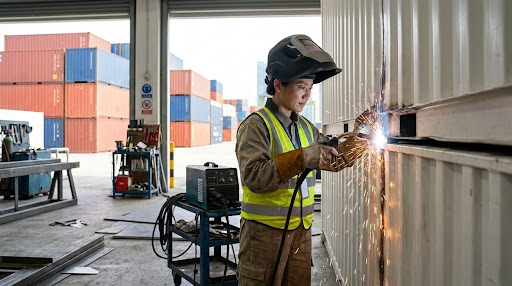
The most common structural modification is cutting additional door or window openings into the container's side or end walls. ISO 1496 specifies that any structural opening must be reinforced with a steel frame welded to the surrounding corrugated panels to restore the panel's load-bearing capacity. AML's fabricators weld ISO-compliant header and sill frames for all openings, maintaining the container's certifiable structural integrity.
Insulation Upgrades
Dry containers have no insulation. Adding closed-cell spray polyurethane foam (50–100mm thickness) to walls, ceiling, and floor creates a thermally controlled environment suitable for temperature-sensitive storage, comfortable office use, or cold room conversion. For reefer container insulation upgrades, PIR panels are added to the interior to improve the K-value beyond the factory specification.
Electrical Points and DB Boards
Full electrical fit-outs include a Distribution Board (DB), LED lighting, multiple power points, data cabling conduits, and where required, a dedicated circuit for air-conditioning. All electrical works must be certified by a licensed electrical worker (LEW) in Singapore. AML coordinates LEW certification as part of every electrical modification package.
Shelving and Internal Fit-Out
Purpose-built shelving systems — heavy-duty steel for parts or equipment storage, stainless steel for food-grade applications — are fabricated and welded or bolted to container walls. Internal partitions, workbenches, and locker installations are handled by AML's in-house fabrication team.
Reefer Container Modifications
Reefer containers can be modified to add side doors, improve insulation ratings, install additional shelving systems, or retrofit new refrigeration units. These modifications require more careful engineering than dry container work because any structural cut affects the thermal envelope. AML's experience with both structural fabrication and modular cold storage solutions ensures reefer modifications maintain food-grade and pharmaceutical cold chain compliance.
Budget vs Build Quality: Understanding the Trade-offs
| Modification Level | What's Included | Typical Cost Range (SGD) |
|---|---|---|
| Basic structural | Door or window cut-out with steel frame, basic paint touch-up | $800 – $2,500 |
| Functional fit-out | Insulation, lighting, power points, DB board, basic flooring | $4,000 – $9,000 |
| Office/habitable | Full insulation, AC, LED lighting, full electrical, windows, security grilles | $8,000 – $18,000 |
| Premium custom | Partitions, cladding, furniture, branding, plumbing, stainless shelving | $18,000 – $40,000+ |
Questions to Ask Before Hiring a Modifier
Before signing any contract for container modification work in Singapore, ask these questions:
- Do you perform structural modifications in-house, or subcontract the fabrication?
- Can you provide examples of completed modifications similar to my requirement?
- Are your electrical works performed by or coordinated with a licensed electrical worker (LEW)?
- Will the modification maintain ISO structural compliance if the container needs to be re-certified?
- What is the lead time from deposit to delivery, and what are the payment milestones?
- Do you offer a defects liability period, and what does it cover?
ISO Compliance: What Modifications Are Permissible?
| Modification Type | ISO Compliance Consideration |
|---|---|
| Door or window openings | Must be reinforced with welded steel frame — AML designs to ISO 1496 |
| Insulation addition (interior) | Non-structural — no ISO impact; reduces internal volume |
| Electrical installation | Non-structural — requires LEW certification in Singapore |
| Shelving (bolted or welded) | Welded connections require engineering assessment for heavy loads |
| Roof penetrations (AC, vents) | Must be sealed and reinforced to maintain waterproofing and roof integrity |
Lead Times and Project Management
| Project Type | Typical Lead Time |
|---|---|
| Basic structural cut (door/window opening) | 3–5 working days |
| Functional storage fit-out (insulation + electrical) | 7–12 working days |
| Office or habitable unit (full M&E + AC) | 14–21 working days |
| Reefer container modification (cold room retrofit) | 14–21 working days |
| Premium custom build (partitions, plumbing, cladding) | 28–45 working days |
Frequently Asked Questions
Q1: Will modifying a container void its ISO certification?
Structural modifications that are not properly engineered and reinforced can compromise ISO certification. AML designs all structural modifications to maintain ISO 1496 compliance and can provide documentation to support re-certification if required by a shipping line or port authority.
Q2: Can I modify a rented container?
Generally no — modifications are only permitted on purchased containers. If you need a modified unit on a rental basis, AML maintains a fleet of pre-modified containers available for hire.
Q3: How long does a typical modification take?
Lead times depend on scope. Basic structural cuts take 3–5 working days. Full office or habitable fit-outs typically take 2–4 weeks. Complex custom builds with plumbing, full cladding, and bespoke furniture may take 4–8 weeks.
Q4: Can you modify a container I already own?
Yes. Bring your container to AML's Singapore workshop for modification, or for larger fleets, AML can discuss on-site modification arrangements.
Q5: Do you provide container modification for reefer containers specifically?
Yes. AML has specialist experience modifying reefer containers — adding side doors, upgrading insulation, fitting new refrigeration units, or installing custom shelving — while maintaining cold chain compliance. This capability is rare among Singapore fabricators.
Have a container modification project in mind? AML's fabrication team handles everything from simple structural cuts to fully fitted office and cold room builds. Talk to us about your requirement and we will produce a design and quote. Enquire with AML today.
