Introduction
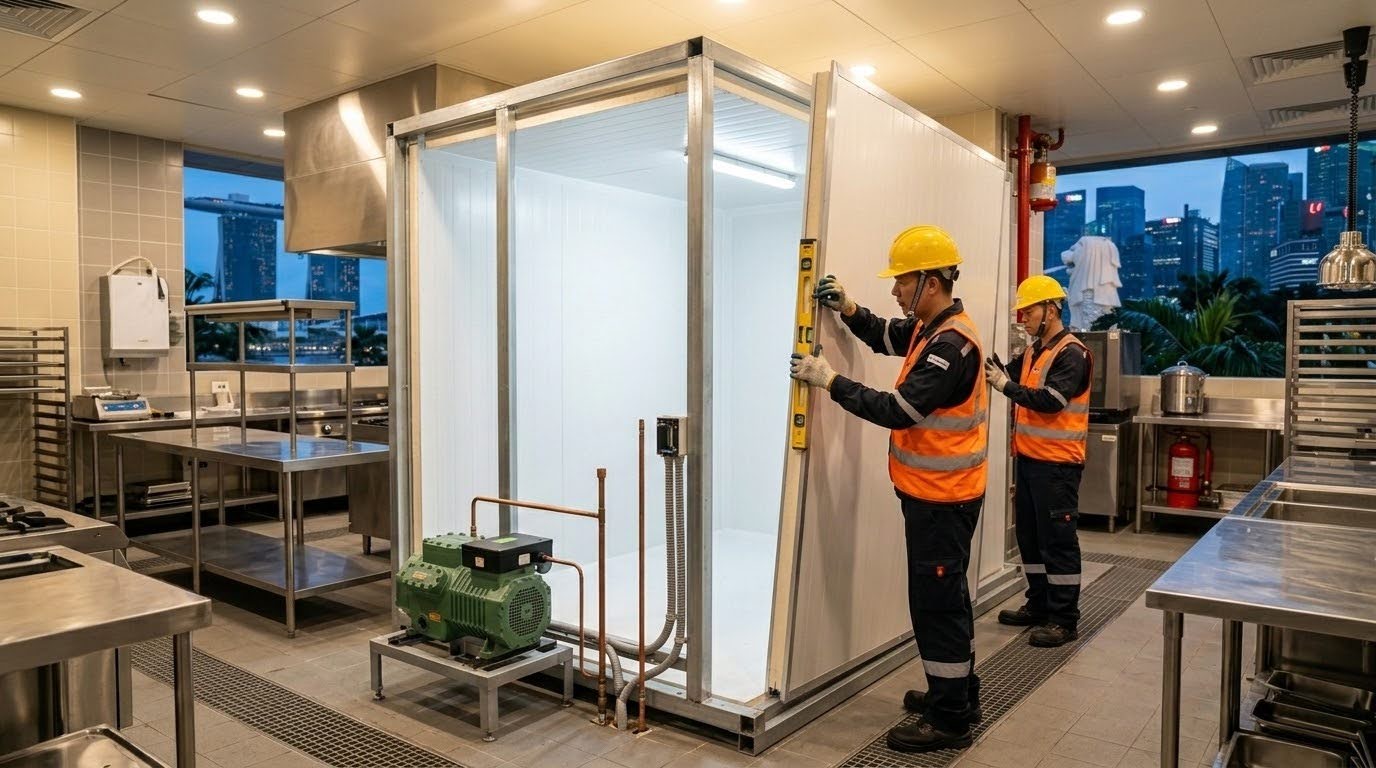
Singapore's food and beverage sector operates under some of the world's most rigorous cold chain standards, enforced jointly by the Singapore Food Agency (SFA) and the National Environment Agency (NEA). For restaurant operators, central kitchen managers, and F&B entrepreneurs, a properly designed and installed cold room is not a luxury — it is a legal and operational necessity. Whether you are installing your first walk-in chiller or upgrading an ageing system, this guide walks through every stage of the process. Advance Marine & Logistics (AML) has delivered modular cold storage solutions for F&B operators across Singapore since 2005.
Step 1: Pre-Installation Planning
Sizing Your Cold Room
The most common cold room planning mistake is undersizing. A cold room that is too small forces staff to over-stack, blocking air circulation and creating warm spots that compromise food safety. Use this formula as a starting point:
- Estimate the maximum volume of stock you will hold at peak capacity
- Allow 60–70% usable volume (walls, shelving frames, and air circulation consume the rest)
- Add 20% buffer for business growth over the next 3–5 years
- For restaurants: a minimum of 6–8 sqm is typical for operations seating 50–80 covers
- For central kitchens: 20–50 sqm cold rooms are common, with separate chiller and freezer zones
Temperature Zoning
Most F&B operators need more than one temperature zone. Plan your zones before construction begins:
| Zone | Temperature Range / Suitable Products |
|---|---|
| Dry store (ambient) | +18°C to +25°C — dry goods, canned items, spices |
| Chiller (fresh) | +1°C to +4°C — seafood, dairy, raw meat, cooked foods |
| Vegetable chiller | +4°C to +8°C — fresh produce, fruits, herbs |
| Freezer | -18°C to -22°C — frozen meats, ice cream, pastry |
| Deep freeze (specialist) | -25°C to -30°C — bluefin tuna, specialty frozen product |
Step 2: Insulation Selection
Insulation is the most critical structural component of any cold room. Two materials dominate the Singapore market:
Polyurethane (PU) Foam Panels
The most widely used insulation in Singapore's F&B cold rooms. PU panels offer an excellent thermal resistance (R-value of approximately R-25 per 100mm thickness), are moisture-resistant, and meet SFA hygienic surface requirements. Standard panel thickness: 100mm for chillers, 150mm for freezers.
Polyisocyanurate (PIR) Panels
PIR panels offer approximately 10–15% better thermal performance than PU at the same thickness, making them the preferred choice for deep-freeze applications or where space is constrained. PIR also has better fire resistance — a consideration for SFA-licensed kitchens where fire compartmentalisation requirements apply.
Step 3: Refrigeration System Options
The refrigeration system drives the operational cost of your cold room for its entire lifespan. Select the right system type for your scale and budget:
| System Type | Best For / Key Characteristics |
|---|---|
| Monoblock (wall-mounted) | Small cold rooms under 15 sqm. Self-contained, easy to install, lower upfront cost. Less efficient for large volumes. |
| Split system (remote condensing unit) | Mid-size cold rooms 10–40 sqm. Compressor located outside or on rooftop, reducing kitchen noise and heat. More efficient. |
| Central refrigeration (rack system) | Large central kitchens with multiple zones. One compressor serves all cold rooms. Highest efficiency, significant upfront cost. |
| Modular cold room (AML) | Flexible, scalable, and fully relocatable. PU panels assembled on-site. Ideal for businesses that may expand or move premises. |
Step 4: SFA and NEA Compliance Requirements
All cold rooms in licensed F&B premises must comply with the Singapore Food Agency's Environmental Health requirements and, where applicable, the NEA's Environmental Protection and Management Act. Key compliance points:
- Temperature logging: all chiller and freezer units must maintain records showing compliance with required temperature ranges
- Surface materials: internal walls, floors, and ceilings must be smooth, impervious, and easy to clean — SFA does not permit exposed insulation foam
- Door seals: magnetic door gaskets must be intact and form a full seal — inspectors check this during licensing visits
- Drainage: cold room floors must drain effectively to prevent standing water
- Separation: raw and ready-to-eat food must be stored in physically separate zones or clearly demarcated shelving
Post-Installation Monitoring
Once your cold room is operational, continuous temperature monitoring is both a regulatory requirement and a practical safeguard. AML offers wireless temperature monitoring for cold rooms — IoT sensors that log temperature and humidity continuously and send instant SMS or app alerts if readings drift outside your set parameters. For SFA-licensed premises, this digital log can be used as compliance documentation during inspections, replacing paper-based manual recording.
Maintenance Tips to Extend Cold Room Lifespan
A cold room is a long-term capital investment. The following maintenance practices, applied consistently, can extend the operational life of your system by 5–10 years and prevent the most common failure modes seen in Singapore's F&B sector:
- Condenser coil cleaning — monthly in Singapore's dusty, humid environment. A dirty condenser reduces heat rejection efficiency and forces the compressor to overwork, shortening its life
- Door gasket inspection — monthly. Run your hand around the closed door perimeter; any cold air leaking out indicates a compromised seal requiring immediate replacement
- Evaporator defrost check — weekly. Ice buildup on the evaporator coil that does not clear during the defrost cycle indicates a failed defrost heater or timer
- Temperature log review — daily. Unusual temperature patterns, such as longer pull-down times or more frequent compressor cycling, are early indicators of refrigerant loss or insulation degradation
- Floor drain inspection — monthly. Clear any food debris from the drain to prevent blockages that cause pooling inside the cold room
Frequently Asked Questions
Q1: How long does a cold room installation take?
A modular cold room installation by AML typically takes 3–7 working days for a standard F&B chiller or freezer room, depending on size and complexity. Split-system refrigeration requires additional time for pipework and electrical connection. AML coordinates all trades to minimise kitchen downtime.
Q2: Do I need planning permission for a cold room in Singapore?
For cold rooms installed within an existing licensed F&B premises, planning permission is generally not required. However, structural modifications to the building shell may require BCA approval. AML advises on regulatory requirements during the pre-installation consultation.
Q3: Can I use a reefer container as a temporary cold room during renovations?
Yes. Many F&B operators rent a reefer container as temporary cold storage while their cold room is being installed or upgraded. AML supplies reefer containers for temporary cold storage with flexible short-term rental terms.
Q4: What maintenance does a cold room require?
Key maintenance tasks include monthly condenser coil cleaning, quarterly door gasket and seal inspection, annual refrigerant level check, and continuous temperature log review. AML offers maintenance contracts covering all these items.
Q5: What is the typical lifespan of a modular cold room?
A well-maintained modular cold room with quality PU panels will last 15–20 years. The refrigeration unit typically requires replacement or major overhaul at 10–15 years depending on operating hours and maintenance quality.
Planning a cold room for your restaurant, central kitchen, or F&B facility? AML designs, supplies, and installs modular cold storage built to SFA compliance standards. Talk to our team for a site assessment and quote. Enquire with AML today.
